Disabled people and shared transport


Improving access to shared micromobility for disabled people
The scope of shared micromobility schemes has expanded over recent years to include e-bikes and e-scooters. While this has opened up the benefits of shared modes to more people, plus the CoMoUK Annual Report shows that 7% of users have a long-term health condition which affects daily activity, we want to see this figure increase to broaden inclusion and access.
Our collaborative research
Research CoMoUK collaborated on with RiDC (Research Institute of Disabled Consumers), commissioned by the Motability Foundation, found that many more disabled people would like to access services but there were several barriers preventing this.
The report, Raising the bar - Boosting the accessibility of shared micromobility, identified three core areas to improve:
Awareness and education
Accessible vehicle design
Accessible digital platforms

Raising the bar - Boosting the accessibility of shared micromobility

Supersmith shared 3Scooter pilot project
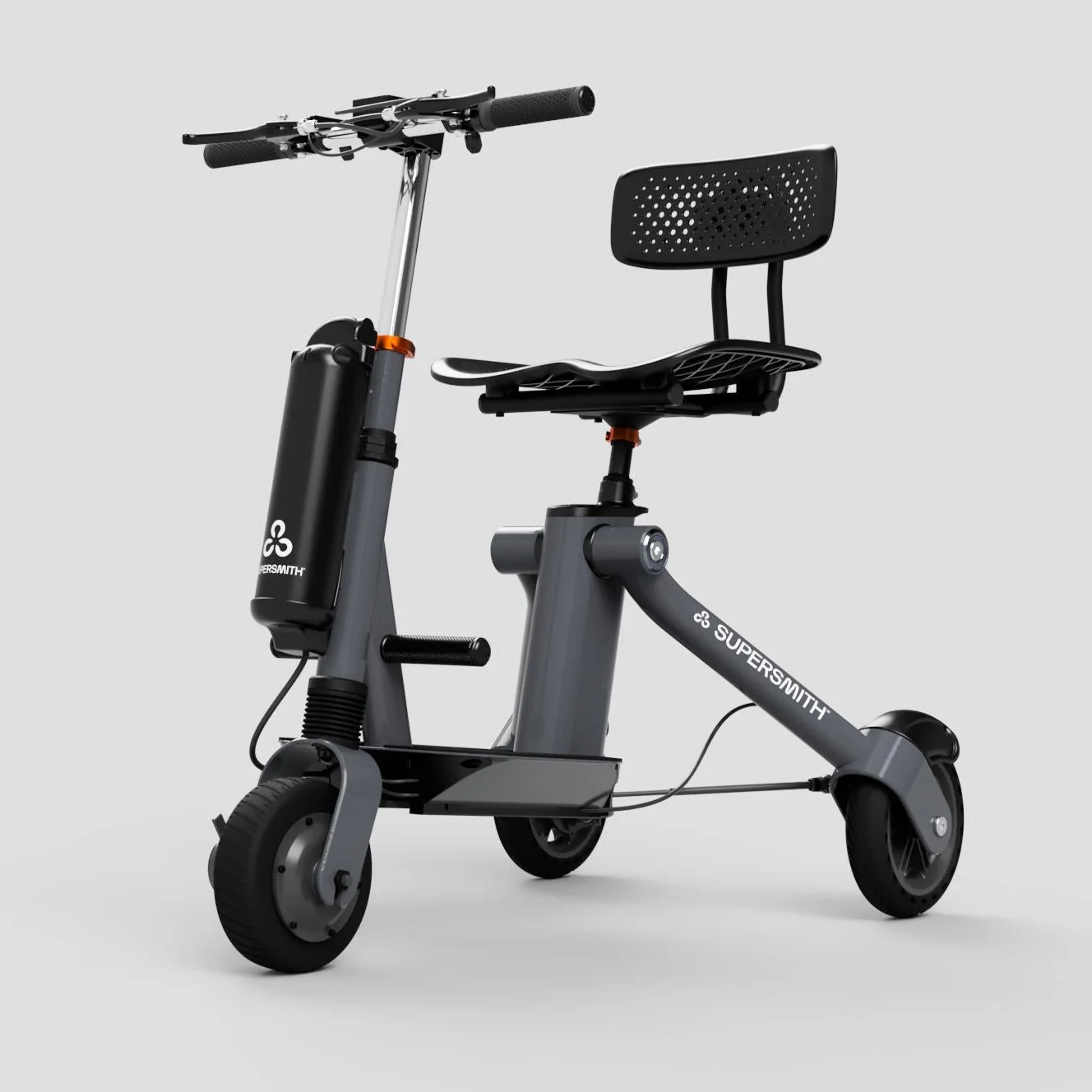
CoMoUK is leading a consortium—including Supersmith, TRL, MOBY, LLDC, Wheels for Wellbeing, and Disability Rights UK—to launch a shared mobility pilot at Queen Elizabeth Olympic Park, London. Funded by the Motability Foundation, the project deploys a fleet of innovative, self‑balancing, three‑wheel seated e‑scooters (Supersmith’s 3Scooter) to evaluate how accessible micromobility increases independence and activity levels for the local disabled community.
The pilot runs through May 2028, with key findings scheduled for publication in August 2028. Please get in touch to learn more.
Shared micromobility engagement project
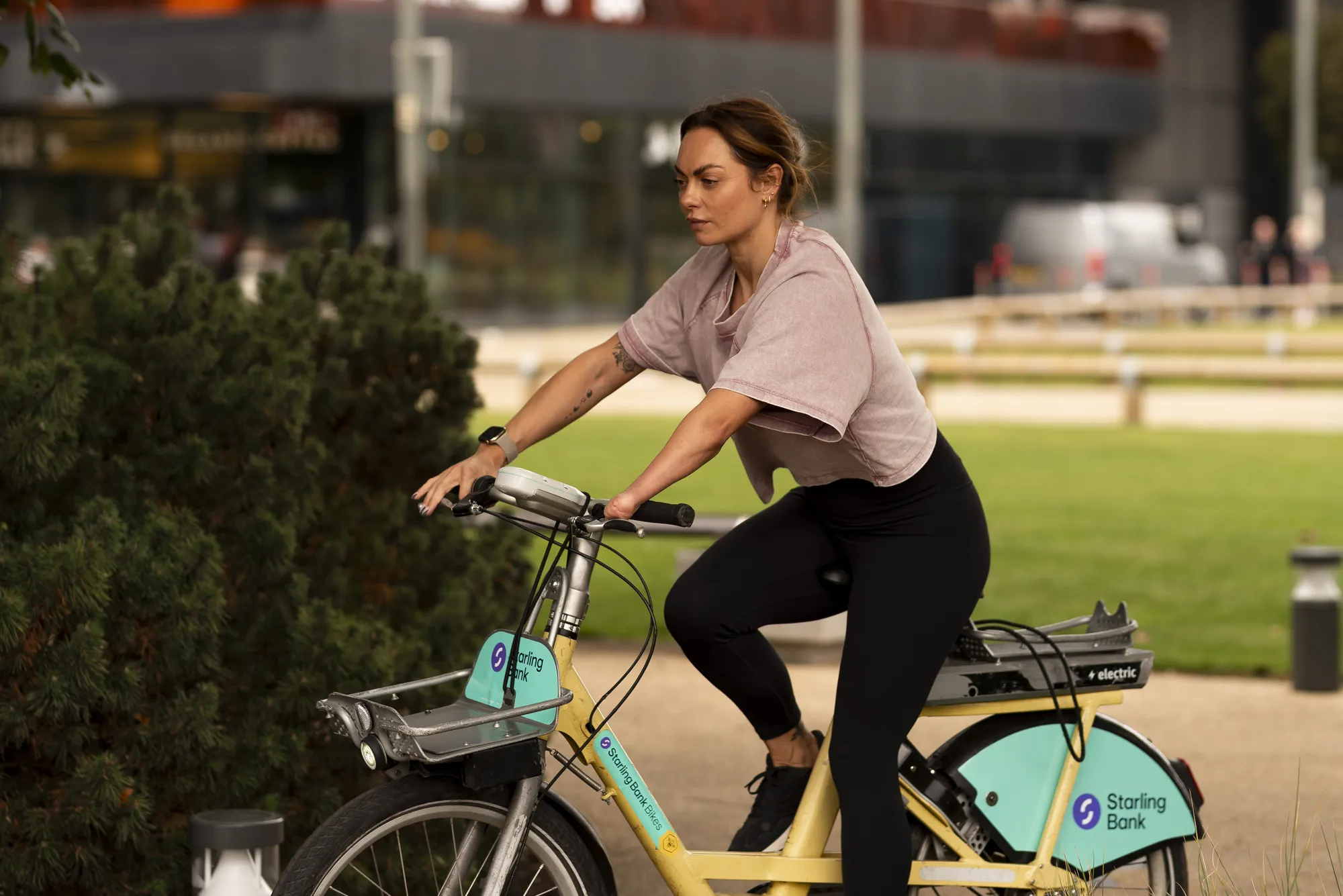
In 2025, we partnered with Cycling UK, Salford City Council, Lime, and Beryl on a project funded by the Motability Foundation to help disabled people use shared e-bikes and e-scooters.
Key insights:
- Engagement: Targeted social media and local networks were vital; 51% of participants joined via word-of-mouth or group emails.
- Barriers: Prior to training, 43% cited safety concerns and 27% struggled with app usage.
- Training impact: Cycling UK’s off-road sessions successfully built confidence through hands-on practice.
- Future use: Post-training, 71% were likely to use Starling Bank e-bikes and 43% intended to use Lime e-scooters independently.
The project confirms that combining targeted promotion with supported, safe environments effectively increases disabled people’s access to shared micromobility. Read more in the full project report:


Improving access to cars clubs for disabled people
Research has been carried out by CoMoUK with TRL, funded by the Motability Foundation, to look at car clubs and disabled people’s needs, challenges and opportunities with them.
The research has involved reviewing academic literature, interviews with key stakeholders and carrying out surveys and focus groups. The research has identified key barriers which need to be addressed.
Along with our partners TRL we are now looking at what actions could in future be piloted to boost access. The research report and recommendations will be published in spring 2025.

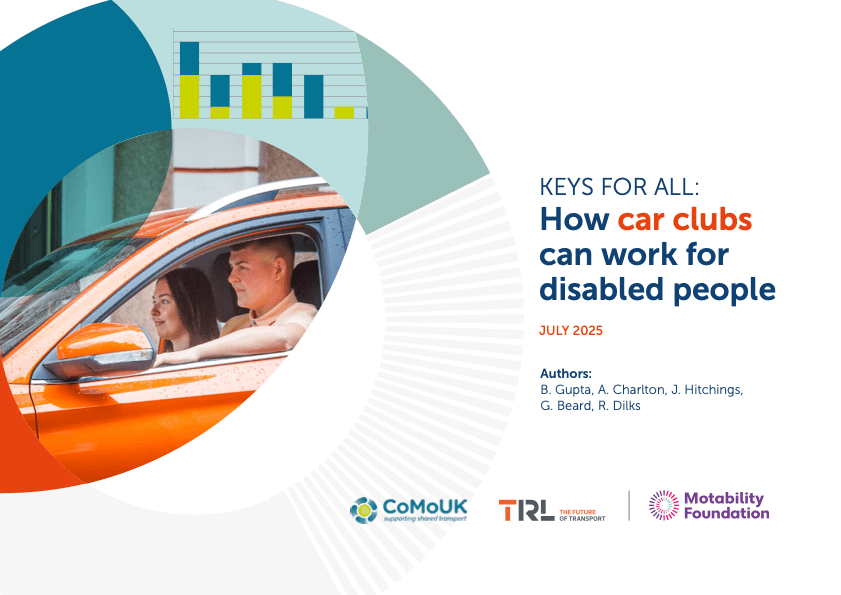
Keys for all: How car clubs can work for disabled people
This research was carried out by CoMoUK with TRL, funded by the Motability Foundation, to look at car clubs and disabled people’s needs, challenges and opportunities with them.
The report is the result of the first ever in-depth investigation into the barriers facing disabled people in accessing car clubs, with the aim of making them more inclusive.
The report sets out a vision for inclusive car clubs, where staff would be equipped with the knowledge and skills to provide high quality support for disabled people, through a range of possible solutions:
- A major awareness raising campaign and improvements to car club websites and apps so they are easier to use.
- A “full audit” of the accessibility of car club websites, apps and communications so they are optimised for disabled people, and specialist training for car club staff.
- A pilot which would test out ways of making car clubs more attractive for disabled consumers, such as trial a discount system and more flexible cancellation policies recognising the unpredictable nature of certain impairments.
- Better information about the accessibility of car club vehicles to be made available by operators, as well as backing the rollout of a wider range of adapted vehicles over the longer term.
Along with our partners TRL we are now looking at what actions could in future be piloted to boost access.