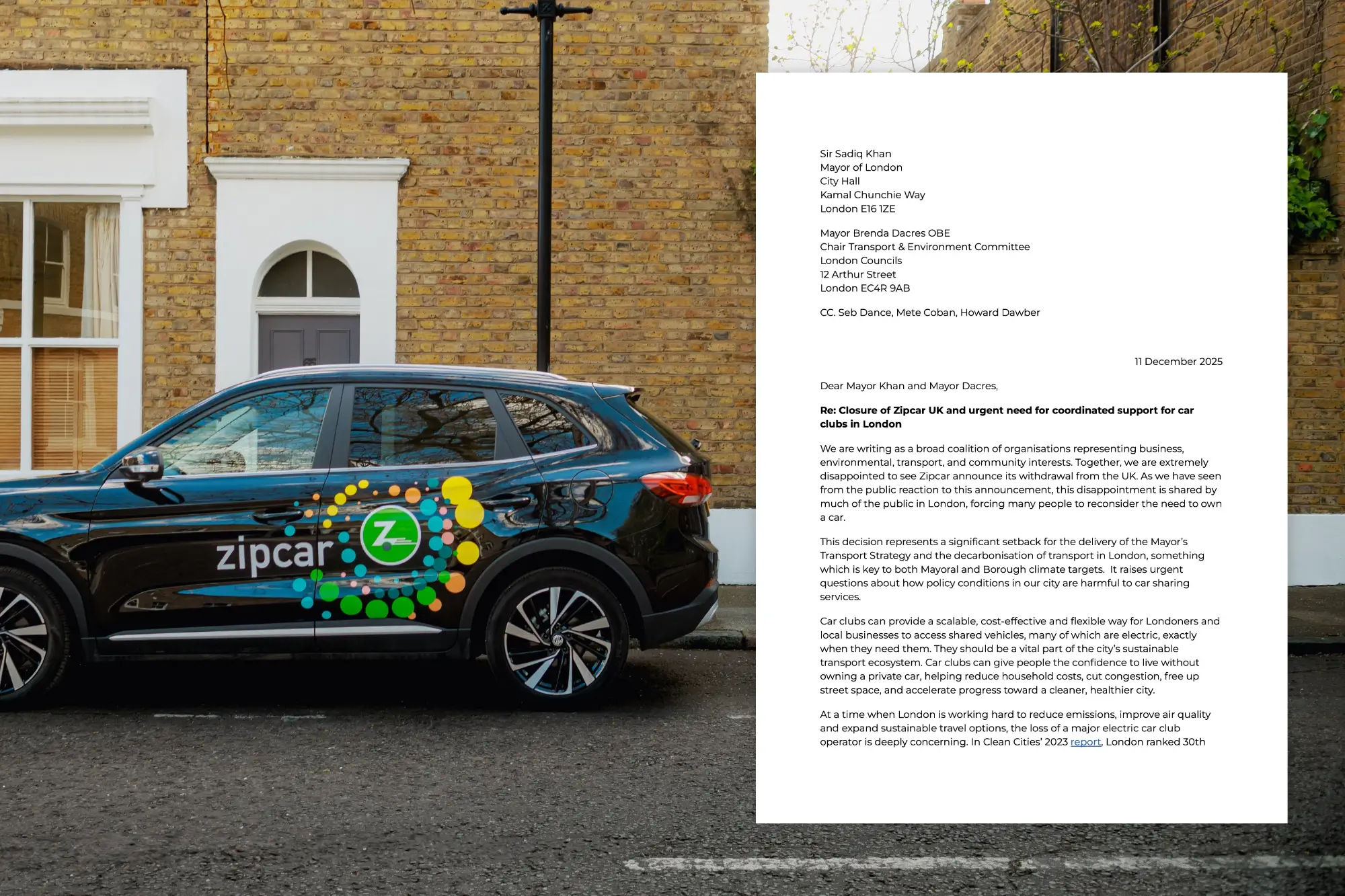

We have composed this letter in conjunction with the Clean Cities campaign, calling on the Mayor of London Sir Sadiq Khan and Mayor Brenda Dacres OBE in her role as Chair of London Councils’ Transport and Environment Committee.
We were delighted to be joined by signatories from: Hiyacar - Co Wheels - Mobilityways - London Borough of Newham - Caroline Russell AM - University of Birmingham - University of Bath - University of Leeds - FSB London - Centre for London - Ashden Climate Solutions - New AutoMotive - Mums for Lungs - Solve the School Run - Clean Air in London - Client Earth - Global Action Plan - T&E - Green Alliance - Clean Air Fund - Campaign for Better Transport - Community Transport Association - Modeshift - London Living Streets - CPRE London.
It calls on the Mayors to:
You can read the full letter below.
Sir Sadiq Khan
Mayor of London
City Hall
Kamal Chunchie Way
London E16 1ZE
Mayor Brenda Dacres OBE
Chair Transport & Environment Committee
London Councils
12 Arthur Street
London EC4R 9AB
Dear Mayor Khan and Mayor Dacres,
Re: Closure of Zipcar UK and urgent need for coordinated support for car clubs in London
We are writing as a broad coalition of organisations representing business, environmental, transport, and community interests. Together, we are extremely disappointed to see Zipcar announce its withdrawal from the UK. As we have seen from the public reaction to this announcement, this disappointment is shared by much of the public in London, forcing many people to reconsider the need to own a car.
This decision represents a significant setback for the delivery of the Mayor’s Transport Strategy and the decarbonisation of transport in London, something which is key to both Mayoral and Borough climate targets. It raises urgent questions about how policy conditions in our city are harmful to car sharing services.
Car clubs can provide a scalable, cost-effective and flexible way for Londoners and local businesses to access shared vehicles, many of which are electric, exactly when they need them. They should be a vital part of the city’s sustainable transport ecosystem. Car clubs can give people the confidence to live without owning a private car, helping reduce household costs, cut congestion, free up street space, and accelerate progress toward a cleaner, healthier city.
At a time when London is working hard to reduce emissions, improve air quality and expand sustainable travel options, the loss of a major electric car club operator is deeply concerning. In Clean Cities’ 2023 report, London ranked 30th out of 42 cities in deploying electric car clubs – ranking behind major cities including Paris, Rome, Brussels and Berlin. Without decisive action to ensure the viability of car clubs, London risks falling even further behind other global cities that are leveraging shared, electric mobility as a cornerstone of their climate and transport strategies.
We believe that this situation calls for the Mayor of London and London boroughs to work together with urgency to create more favourable conditions for car clubs to operate and expand. In particular, we encourage you to jointly consider the following measures:
Without coordinated leadership and pragmatic policy adjustments, the departure of Zipcar will dent London’s reputation as a world-leading city for innovative, low-carbon mobility. The withdrawal of London’s main car club operator should be a wake-up call, but it is also an opportunity to redefine and strengthen the conditions needed for car clubs to grow, compete and serve communities across the capital and deliver the associated modal shift and environmental benefits. This is an opportunity to claim the mantle of leadership in car clubs and show other cities what good policy looks like.
Given the urgency of this issue, we request a joint meeting with you both at the earliest opportunity to discuss immediate actions and a shared approach to safeguarding and expanding shared electric mobility in London.
We would welcome the chance to work with you and your teams to ensure that car sharing becomes a central pillar of London’s transport and climate strategy.
Yours sincerely,
Richard Dilks, Chief Executive, CoMoUK
Matthew Clark, Chair, CoMoUK
Zak Bond, Campaign Manager, Clean Cities
Marc Roberts, Chief Technology & AI Officer, Hiyacar
Don Iro, Chief Executive, Hiyacar
Richard Falconer, Founder, Co Wheels
Robert Schopen, Partnerships Manager, Co Wheels
Ali Clabburn, CEO, Mobilityways
Laura Timm, Regional Chair, FSB London
Antonia Jennings, CEO, Centre for London
Dr Ashok Sinha, CEO, Ashden Climate Solutions
Cllr Sarah Ruiz, Deputy Mayor, Sustainable Transport, London Borough of Newham
Jemima Hartson, Founder and Director, Mums for Lungs
Nicola Pastore, Director & Co-Founder, Solve the School Run
Simon Birkett, Founder and Director, Clean Air in London
Kyle Lischak, Head of UK, ClientEarth
Catherine Kenyon, Head of Clean Air, Global Action Plan
Tim Dexter, UK Policy Manager, T&E
Nicholas Davies, Head of Climate Policy, Green Alliance
Nick Smith, Head of UK, Clean Air Fund
Ben Plowden, CEO, Campaign for Better Transport
Tom Fyans, Chief Executive, London Cycling Campaign
Ben Nelmes, Executive Director, New AutoMotive
Alice Roberts, Head of Campaigns, CPRE London
Jeremy Leach, Chair, London Living Streets
Nick Butler, Chief Operating Officer, Modeshift
David Kelly, Head of Policy and Campaigns, Community Transport Association
Caroline Russell AM, London Assembly
Prof. Greg Marsden, University of Leeds
Dr. Dilum Dissanayake, University of Birmingham
Pete Dyson, Doctoral researcher, University of Bath